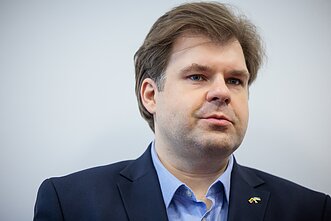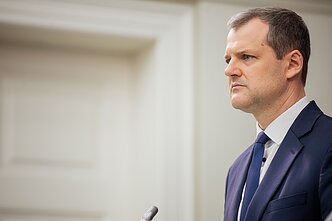
















Decisions on the permanent deployment of a German brigade in Lithuania depend on NATO's position, German Defence Minister Boris Pistorius said in Vilnius on Tuesday.
"This not down to who wants what – or who wants to provide what – but rather up to NATO," Pistorius said.
Infrastructure is also needed for the brigade's deployment in Lithuania, including accommodation for troops and their families, he told reporters during his visit to Pabradė, eastern Lithuania.
The minister repeated this position at a joint press conference with his Lithuanian counterpart, Arvydas Anušauskas, in Vilnius later in the day.
"The question is not so much about what Germany plans to do, but rather what NATO considers necessary. We have a brigade assigned to Lithuania and Lithuania has already started the process of installing the necessary infrastructure," he said.
A brigade needs 5,000 troops, as well as "several battalions of armoured vehicles", Pistorius added.

"Finally, we are raising another question: what does NATO say about this? What is necessary from the military side, what is needed? Do we need to have a brigade permanently deployed in the Baltic states?" he said.
Berlin is now leading the multinational NATO battalion deployed in Lithuania since 2017 and has also assigned a brigade to Lithuania in response to Russia's war in Ukraine.
Vilnius wants a German brigade to be permanently deployed in Lithuania. However, German officials have so far publicly reiterated that only a part of the brigade will be based in Lithuania and some of it at home, adding that it could redeploy quickly, if necessary.
Read more: Lithuanian president critical about German brigade debate: ‘We shot ourselves in the foot’
This has sparked heated political debates in Lithuania and caused friction between Vilnius and Berlin officials.
Asked by German reporters why it's important for Vilnius to have the brigade deployed in Lithuania, Anušauskas pointed out the country's complicated geographical situation.

"Lithuania is located between Belarus, which has lost its military independence, and Kaliningrad. With no doubt, the Baltic defence strategy cannot rely only on reinforcements, as it must also be based on reliable forces in place," he said.
"It is necessary because of our geography," Anušauskas said, adding that Lithuania also needs air defence capabilities.
"Lithuania is, by the way, developing its capabilities. I hope that a decision will soon be made on the creation of a Lithuanian division based on our existing capabilities," Anušauskas said.
The minister also said the threat from Russia is real. Despite the losses in Ukraine, Moscow will be able to restore its capabilities quickly.
"Russia's military capabilities in the Kaliningrad area remain little affected by the war against Ukraine," he said. "The Kremlin's plans for a buildup of forces in the regions bordering NATO show [Russia’s] commitment to a long-term confrontation."
Commenting on the permanent presence of German troops, Anušauskas said he hoped continuous military drills would ensure the presence of "at least one German battalion in Lithuania".

‘Credible deterrence’
The assigned German brigade's forward command element is now stationed in Lithuania, serving as the brigade's headquarters, which carries out preparatory work for the brigade and this work is "coordinated with the Lithuanians", the German minister said.
"And the brigade's further deployment in Lithuania will also be coordinated with Lithuania and we will continue our discussions in the upcoming months," Pistorius told the press conference.
In his words, visibility is now key. Having an infantry battalion training in Lithuania shows that "Germany is contributing to convincing and credible deterrence here on the eastern flank", he added.

Newsletter
Every Friday morning.